
- Research
A Quebec innovation positioning INRS among global leaders in advanced materials.

Photo Stock
Metal-organic frameworks, better known as MOFs, are among the most intensely studied materials for addressing major environmental challenges. Their highly ordered, ultra‑porous architecture enables applications ranging from CO₂ capture and air or water purification to catalysis and hydrogen production. It is therefore no surprise that MOFs have drawn global attention in recent years, notably with their recognition by the 2025 Nobel Prize in Chemistry, as they play an increasingly central role in the development of sustainable technologies.
Despite their promise, MOFs remain challenging to synthesize with high precision. Conventional solvotherma methods typically;require high temperatures (up to 200 °C) and long reaction times, making them energy‑intensive and difficul to control. These harsh conditions can compromise structural precision and limit functiona performance.
This constraint has now been overcome by Professor Dongling Ma, a nanomaterials expert at the Institut national de la recherche scientifique (INRS) and Canada Research Chair in Advanced Functional Nanocomposites. In collaboration with researchers from McGill University, her team has developed a photochemical synthesis strategy that enables MOFs to be formed under mild, ambient conditions.

“Our work demonstrates that photons can be used not only to initiate MOF synthesis, but also to guide it with exceptional precision. This strategy opens a sustainable pathway for engineering advanced materials while dramatically reducing energy consumption.”
Dongling Ma, Professor at INRS
Photochemical Synthesis of MOFs at Ambient Temperature
In a study published in Nature Communications, the team at INRS Énergie Matériaux Télécommunications Research Centre reports the ambient‑temperature synthesis (15 °C, 4 hours) of a cobalt–porphyrin‑based MOF, named phoPPF‑3, using light as the sole driving force.
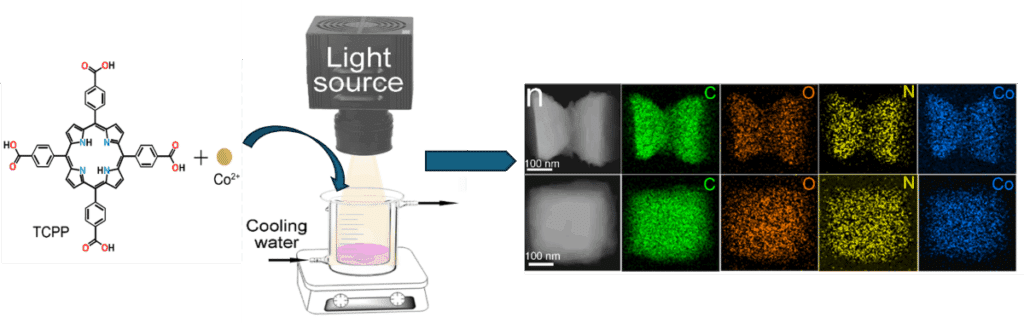
Rather than relying on thermal energy, this light‑driven approach uses photons to initiate and control the assembly process at the atomic scale. The strategy enables multidimensional control over framework formation, resulting in unique two‑dimensional hourglass‑like morphologies. Crucially, it also induces selective Co²⁺–carboxylate coordination, preserving free‑base porphyrin cores that cannot be maintained using conventional solvothermal synthesis. The outcome is a MOF with enhanced structural precision, improved thermal stability, and a level of control previously inaccessible under traditional conditions.
Enhanced Photocatalytic Performance for Future Energy Technologies
Beyond its innovative synthesis, phoPPF‑3 exhibits superior functional performance. Compared with solvothermally synthesized analogues, it demonstrates higher photocatalytic activity in both benzyl alcohol oxidation and photocatalytic hydrogen evolution. In some cases, performance improvements reach up to 50%, highlighting the strong link between synthesis precision and functional efficiency.

“MOFs already play a strategic role in the energy transition. By enabling atomically precise synthesis under ambient conditions, this approach accelerates the development of more efficient and scalable technologies.”
Yong Wang, PhD student in the Materials and Energy program in Dongling Ma’s laboratory at the time the study was conducted.
Importantly, the researchers also demonstrated that this photochemical methodology is not limited to a single system. Its successful extension to other MOFs underscores the generality and versatility of the approach.
By drastically lowering the energy requirements for MOF synthesis while enhancing structural and functional control, this strategy opens new possibilities for large‑scale production and applications such as CO₂ capture, environmental remediation, industrial catalysis, and solar energy conversion and storage.
About the Study
Wang, Y., Guan, J., Kumar, K. et al. Room temperature photochemical synthesis of metal–organic frameworks for enhanced photocatalysis. Nature Communications (2026). https://doi.org/10.1038/s41467-026-70927-w
This research was supported by the Natural Sciences and Engineering Research Council of Canada (NSERC), the Canada Research Chairs Program, the Fonds de recherche du Québec – Nature et technologies (FRQNT), and the National Natural Science Foundation of China.