
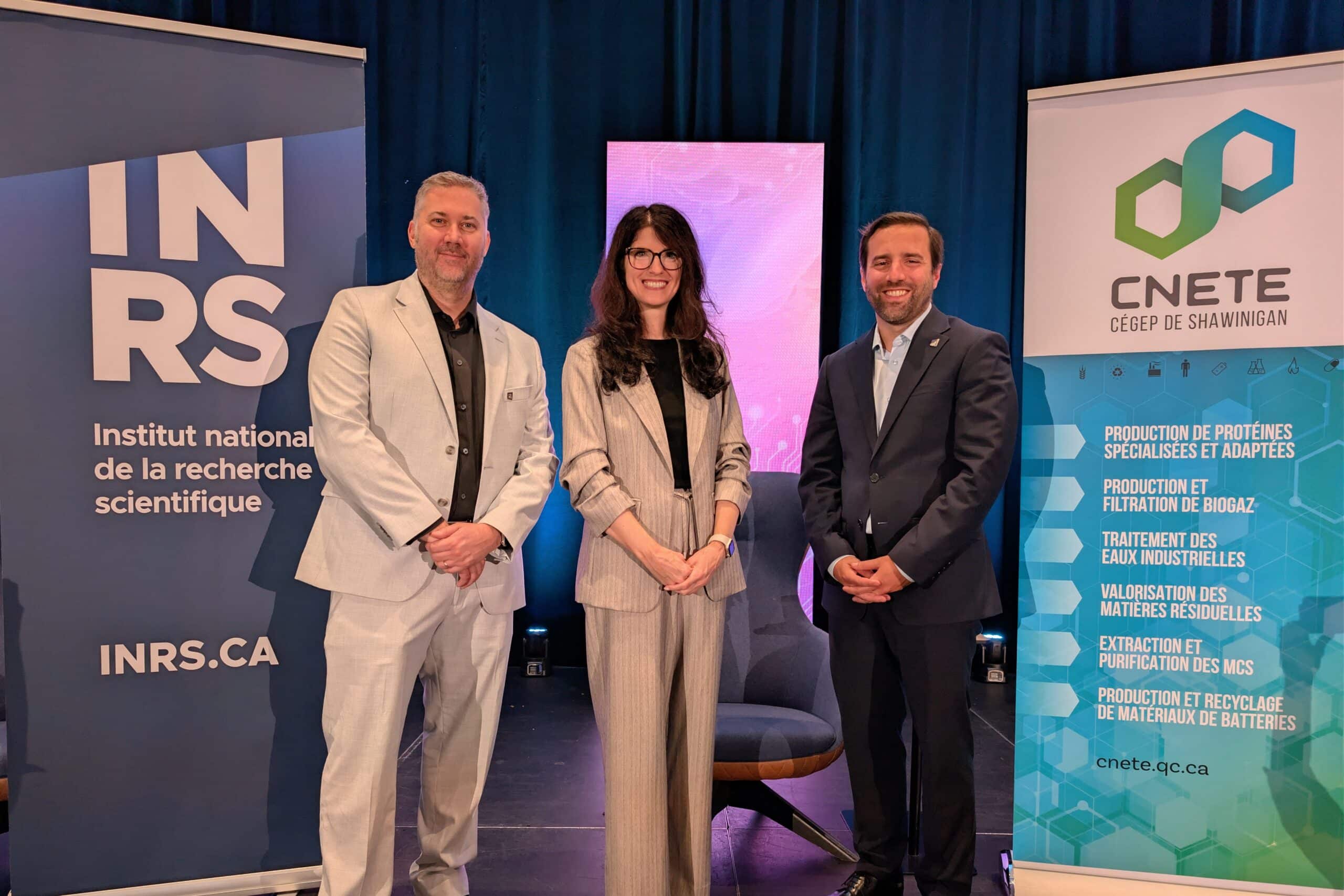
An institutional agreement was signed between the Institut national de la recherche scientifique (INRS) and the Centre national en électrochimie et en technologies environnementales (CNETE), in the presence of Nancy Déziel, Executive Director of CNETE; David Chatenet, Director of the Armand-Frappier Santé Biotechnologie Research Centre,and Louis-César Pasquier, Director of the Eau Terre Environnement Research Centre.

This new collaboration will bring together the expertise of the INRS and the CNETE on projects involving fermentation bioprocesses, with the goal of bridging the gap between research, innovation, and technological development. In particular, the agreement will help establish a stronger continuum in Quebec to support companies in scaling up their processes—complex yet essential steps prior to commercialization.
What led to the formation of this partnership?

The partnership arose from a desire to pool the complementary expertise of INRS and CNETE, natural allies.

The framework agreement is based on a shared vision: to strengthen collaboration in bioprocesses, accelerate innovation, and maximize the benefits of research. In particular, it will support projects of mutual interest and help position Quebec in the strategic bioeconomy sector.

CNETE is a college-based technology transfer center (CCTT) affiliated with the Cégep de Shawinigan, recognized for its expertise in bioprocesses, precision fermentation, environmental technologies, and applied electrochemistry—making them natural allies. Having supported businesses for over 33 years, its mission is to accelerate innovation, optimize processes, and maximize their industrial and economic benefits.

Together, INRS and CNETE will be able to support a broader range of processes to address increasingly complex technological challenges, particularly in emerging fields such as precision fermentation, offering businesses greater flexibility and capacity while fostering the faster development of solutions tailored to industrial realities.

What is at the heart of the research conducted under this partnership?

Fermentation bioprocesses encompass a set of processes that use microorganisms to produce, transform, or recover substances of interest, particularly proteins, but also other biomolecules. They are central to numerous applications in the bioeconomy, health, the environment, and resource recovery.

The agreement aims to support projects that will advance technologies at various stages of maturity, particularly by working on their optimization, validation, and scaling up.

In terms of resources, what form does this partnership take?

The agreement calls for exploring opportunities to share expertise, infrastructure, and resources, as well as to develop skills.

It will enable the establishment of an integrated service offering in bioprocesses and facilitate access to complementary capabilities in research and technological development. For research teams, this complementarity can help bridge certain gaps between laboratory-based proof of concept and the development of technologies at higher levels of technological maturity. 

What is the added value for both organizations in partnering?

CNETE brings expertise in applied research and technological development that complements INRS’s directed research capabilities. INRS, for its part, extends CNETE’s scaling-up capabilities through its large-scale facilities, notably its two 2,000-liter bioreactors. This close collaboration between the two organizations will facilitate the translation of knowledge into applications and promote the development of technologies beyond the initial experimental stages. For INRS, it is also an opportunity to increase the number of cross-departmental and interdisciplinary projects and to strengthen the links between its various areas of expertise in health, the environment, and engineering. 
What can we expect from such a partnership?

This collaboration opens the door to joint projects that can benefit from a continuum ranging from research and design to development and technological maturation. Ultimately, this work could help bring about new solutions in bioprocesses and enhance their potential for application across various sectors, including health (development of vaccines or medications), food (ingredients for both human and animal consumption), and environmental protection solutions. The partnership also aims to increase the utilization of the scientific, technological, and socioeconomic benefits resulting from this work.