
- INRS Publications
Two researchers from Labo Climat Montréal co-edit a collective book on rethinking the city in the face of climate challenges.
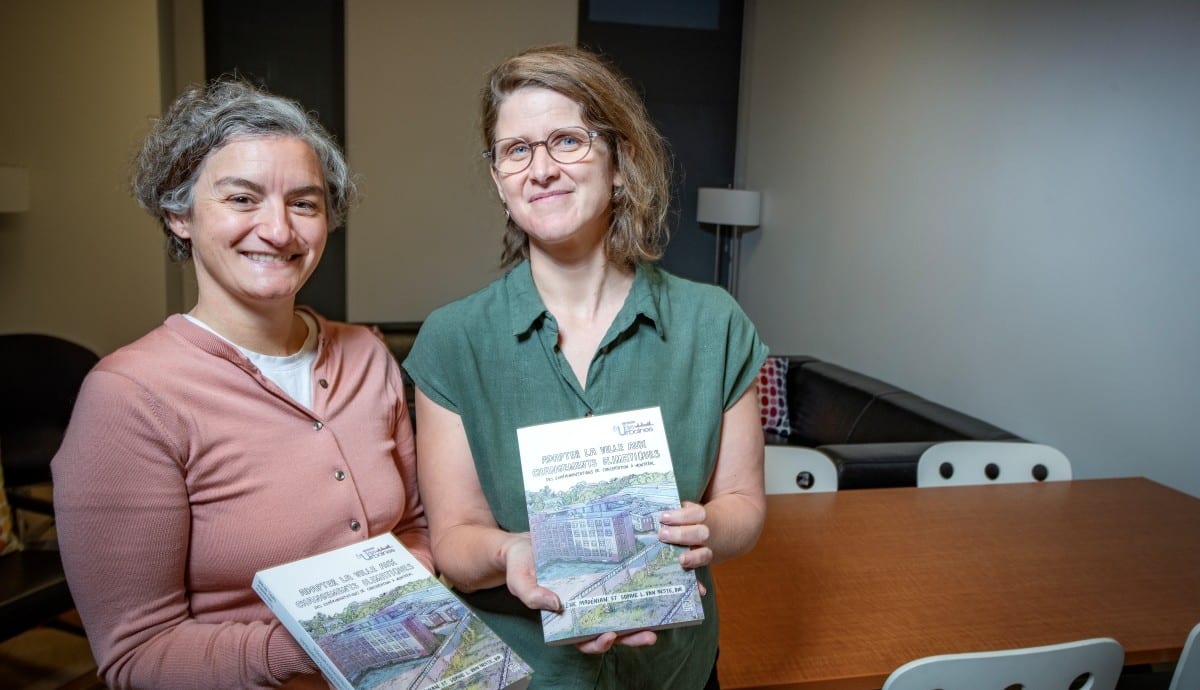
Hélène Madénian and Sophie L. Van Neste Photo : Christian Tremblay
How can cities prepare for climate-related hazards? What does it really mean to “adapt” a neighborhood to heavy rainfall, extreme heat waves, or the social vulnerabilities they exacerbate? The book Adapter la ville aux changements climatiques : des expérimentations de concertation, published by Les Presses de l’Université Laval, offers food for thought and suggests concrete actions to address these challenges. It is co-edited by Professor Sophie L. Van Neste and postdoctoral researcher Hélène Madénian from the Institut national de la recherche scientifique (INRS), both based at the Centre Urbanisation Culture Société Research Centre
A living laboratory in Lachine-Est
The book focuses on a landmark case: the industrial brownfield of Lachine-Est in Montréal. This vast 64-hectare property, which is slated to become an eco-district over the next 20 to 30 years, is being used by Labo Climat Montréal as a true living laboratory. It provides an opportunity to observe how adaptation can be integrated into urban development from the very outset through green infrastructure and by paying special heed to local issues and social needs.
Divided into three parts—transforming urban governance, urban planning, and urban intervention—the book demonstrates that adaptation is about more than just technical solutions such as roads or water systems. True adaptation must include a social dimension. For instance, heat waves disproportionately affect people living in poverty and precarious housing. That means thinking about what makes people vulnerable and how they can be helped, to avoid the trap of green gentrification whereby ecological transition exacerbates social inequalities and excludes local communities.
“The Lachine-Est project is a way to integrate climate adaptation from the start when planning a neighbourhood. When we take the time to reflect on infrastructure and social needs, we can build communities that protect the most vulnerable and account for future challenges.”
Hélène Madénian, a postdoctoral researcher in urban studies
The power of public consultation
At the heart of the book lies the idea that adaptation requires experiments in public consultation. This means creating opportunities for people who do not usually work together—research teams, municipal services, community organizations, citizens—to engage in dialogue, share expertise, and come up with solutions together. According to the authors, collective intelligence like this helps avoid blind spots, such as focusing too narrowly on stormwater management while neglecting inequalities linked to extreme heat.
“This book shows that it’s a mistake to think only institutions can address climate issues. Adaptation must be inclusive and participatory, bringing diverse knowledge to the table and giving voice to people who are often left unheard, in order to build sustainable and equitable neighbourhoods.”
Sophie L. Van Neste, a professor at INRS and expert in environmental, climate, and political action
About the book
The book Adapter la ville aux changements climatiques : des expérimentations de concertation brings together contributions from researchers at UQAM, Université Laval, Université de Montréal, and INRS, as well as from Montréal municipal services and community organizations such as GRAME, Concert’Action Lachine, and Imagine Lachine-Est. Together, they provide a diversity of perspectives that enrich the conversation and open pathways for other cities in Québec, North America, and beyond.