
- Research
Two INRS virologists provide an update.

Photo: Professors Laurent Chatel-Chaix and Sébastien Nisole, virologists at INRS
Ten years after the global Zika crisis—for which WHO declared a public health emergency of international concern in 2016—the virus is still circulating, though under the radar. What do we now know about its risks and its potential to reemerge? Professors Laurent Chatel‑Chaix and Sébastien Nisole, virologists at the Institut national de la recherche scientifique (INRS) and members of the Pasteur Network, share an update on a virus still too often considered a neglected disease.
Ten years after the outbreak, is the virus still circulating today?
Sébastien Nisole: Yes, but at a low level. Before 2015, Zika was largely overlooked and mostly appeared as isolated cases in Africa and Southeast Asia. Later, larger outbreaks occurred in some Pacific islands, leading to the major 2015–2016 crisis in South and Central America.
This epidemic triggered an unprecedented scientific and public health mobilization. However, once the epidemic ended—mainly because herd immunity developed in Latin America—attention gradually faded. Today, the virus is still circulating “under the radar,” particularly in Africa, Asia, South America, and the Caribbean. Cases are reported every year, but they remain sporadic and are generally not considered a major concern for the broader population.
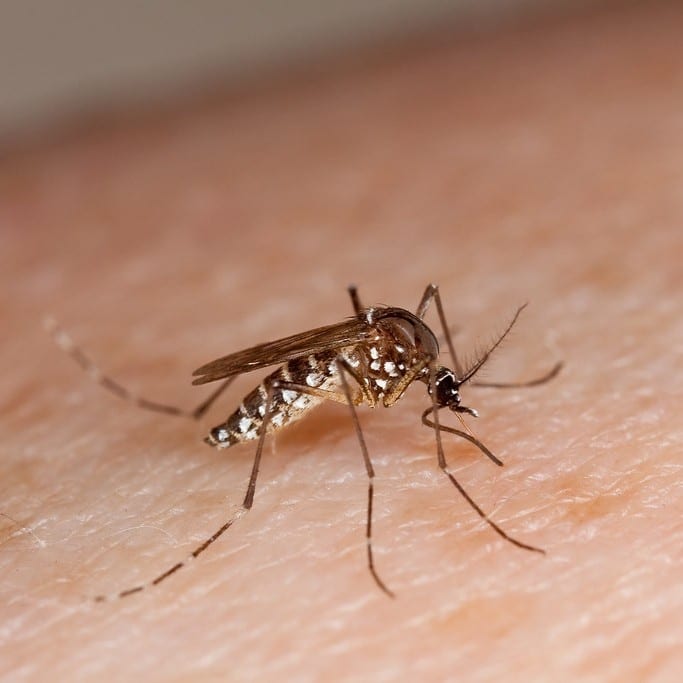
Laurent Chatel‑Chaix: It is also important to remember that about 80% of infections are asymptomatic. An infected person can travel without even knowing it. This phenomenon is now regularlyreported in Europe and even in the United States with the dengue virus, a genetically related virus transmitted by the same mosquitoes. What is unique about Zika is that humans can infect mosquitoes: a non‑infected mosquito can bite a person carrying the virus and become a vector, potentially creating small clusters of transmission.
Finally, with climate change, mosquito species are rapidly expanding into temperate regions. A first locally acquired case of dengue was recently reported near Paris. The numbers remain anecdotal, but symbolically, it is very significant.
Should we fear another epidemic?
Sébastien Nisole: Yes, the risk is still present. Mosquito vectors are spreading worldwide. Aedes aegypti, the main vector of Zika, keeps expanding in tropical and subtropical regions, while Aedes albopictus, the tiger mosquito, is colonizing temperate regions, including Europe and North America. Even though it transmits the virus less efficiently, it can still do so. Locally transmitted cases involving Aedes albopictus have already been reported in France.
While populations in Latin America are now largely immune, this is not the case elsewhere. An epidemic could therefore emerge in a non‑immune population. Viruses never disappear completely—like influenza, they can re‑emerge when herd immunity wanes.
Laurent Chatel‑Chaix: There is still no vaccine or specific treatment against Zika. The potential emergence of a more aggressive strain due to mutation cannot be ruled out. The virus may seem less alarming because it is rarely fatal, unlike other insect‑borne viruses such as dengue.
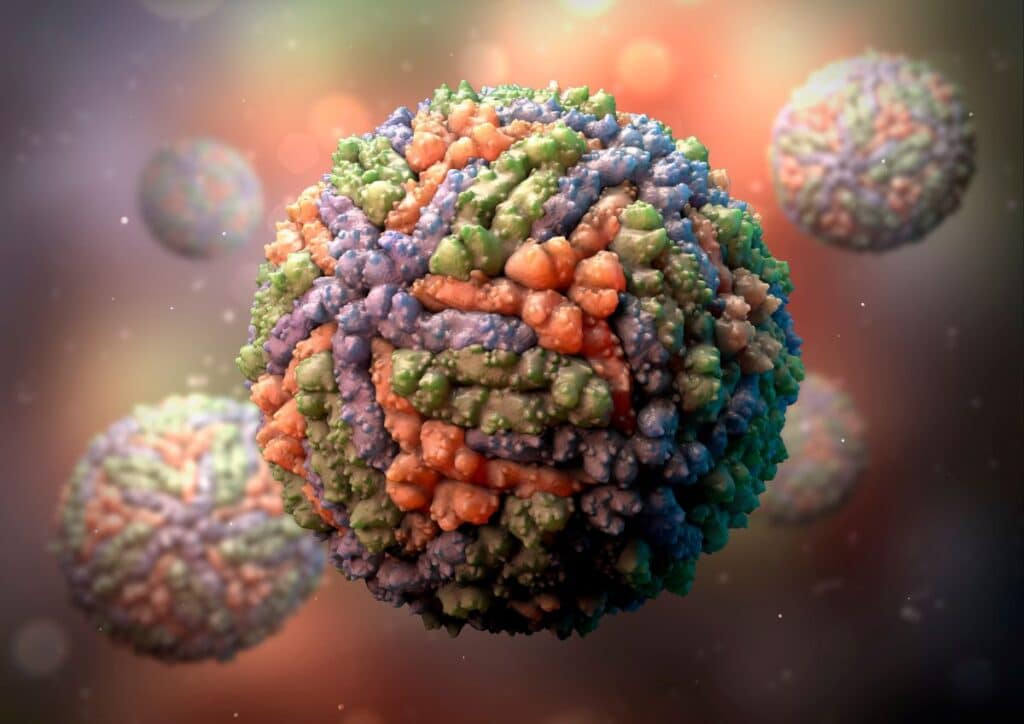
However, Zika and dengue interact with each other. These “cousin” viruses circulate in the same regions, and infection with one can influence the immune response to the other. A previous Zika infection may increase the risk of severe dengue. Although genetically close, the viruses induce very different clinical effects, especially regarding sexual transmission, transmission during pregnancy, and fetal complications. Many mechanisms remain poorly understood.
Why hasn’t Africa experienced a major Zika epidemic despite the virus being present?
Sébastien Nisole: This remains an open question. There are two major Zika virus lineages. The African lineage has circulated on the continent for a long time and is highly virulent in laboratory settings, yet it has never caused large human outbreaks.
In contrast, the Asian lineage—responsible for the Pacific and American epidemics is less virulent in experimental models but far more epidemic. Several hypotheses exist: differences in mosquito species, cross‑immunity with other viruses, or environmental factors. However, none of these factors alone fully explains the situation.
Laurent Chatel‑Chaix: Vector competence is a key parameter: depending on the region, mosquitoes do not all have the same ability to transmit the virus.
What major progress has been made since 2016?
Laurent Chatel‑Chaix: The years following the epidemic were extremely productive.
We learned a great deal about the biology of the virus, its replication, and the mechanisms behind microcephaly and other neurological complications in newborns.
Many studies focused on mosquitoes, notably on factors influencing transmission and differences between viral strains.
Several vaccine candidates were developed and proved effective in laboratory and animal models. However, because the virus circulates at low levels today, launching clinical trials is very challenging—especially among pregnant women, which raises major ethical challenges. The same applies to treatments: financial incentives are limited for the industry because the potential market is small and the most affected countries have fewer resources.
Sébastien Nisole: Some approaches are very promising.
For example, one experimental vaccine does not target the virus itself, but rather proteins in the saliva of Aedes aegypti. Its goal is to block the transmission of multiple viruses at once.
At the same time, vector‑control strategies—such as sterile or genetically modified mosquitoes—are higly effective and could significantly reduce the risk of future epidemics, though they still raise ecological and societal questions.
Is Canada affected by these so‑called “neglected” diseases?
Laurent Chatel‑Chaix: Yes. Zika and dengue are sometimes perceived as distant diseases. Yet, for our colleagues of the Pasteur Network in Africa, Asia, and Latin America, they are major public health priorities. Mosquitoes are already expanding their ecological niches, transmission zones are shifting, and Europe is seeing more and more locally acquired cases of insect‑borne viruses.
Canada is not immune. We already face insect‑borne viruses such as West Nile virus, and others could emerge. We must also consider tick‑borne flaviviruses like Powassan virus or tick‑borne encephalitis virus, which are also spreading.
Sébastien Nisole: In Europe, ten years ago, contracting dengue meant traveling far. Today, you can catch it in France. The range of mosquito vectors is steadily expanding northward year after year. A similar trend is observed in Canada, where Aedes albopictus has begun colonizing Ontario and could continue to spread. New flaviviruses are regularly discovered around the world, and outbreaks can occur anywhere herd immunity is low.
Why is scientific collaboration essential?
Sébastien Nisole: Collaboration is crucial. The Zika epidemic, combined with the Ebola crisis, accelerated the shift toward open science: rapid data sharing and early dissemination of results through preprint platforms. These practices played a key role in the rapid response to the COVID‑19 pandemic. The opportunity to work closely with Laurent was one of the reasons I joined the INRS Armand-Frappier Santé Biotechnologies Research Centre, in Laval.
Laurent Chatel‑Chaix: Our expertise is highly complementary. Sébastien has strong expertise in innate antiviral immunity and cellular defences against flaviviruses. I focus more on the cell biology of flaviviruses and animal models. With access to the containment level 3 laboratory at INRS, in Laval, this collaboration is particularly meaningful. Understanding these viruses today means being better prepared for tomorrow’s crises.
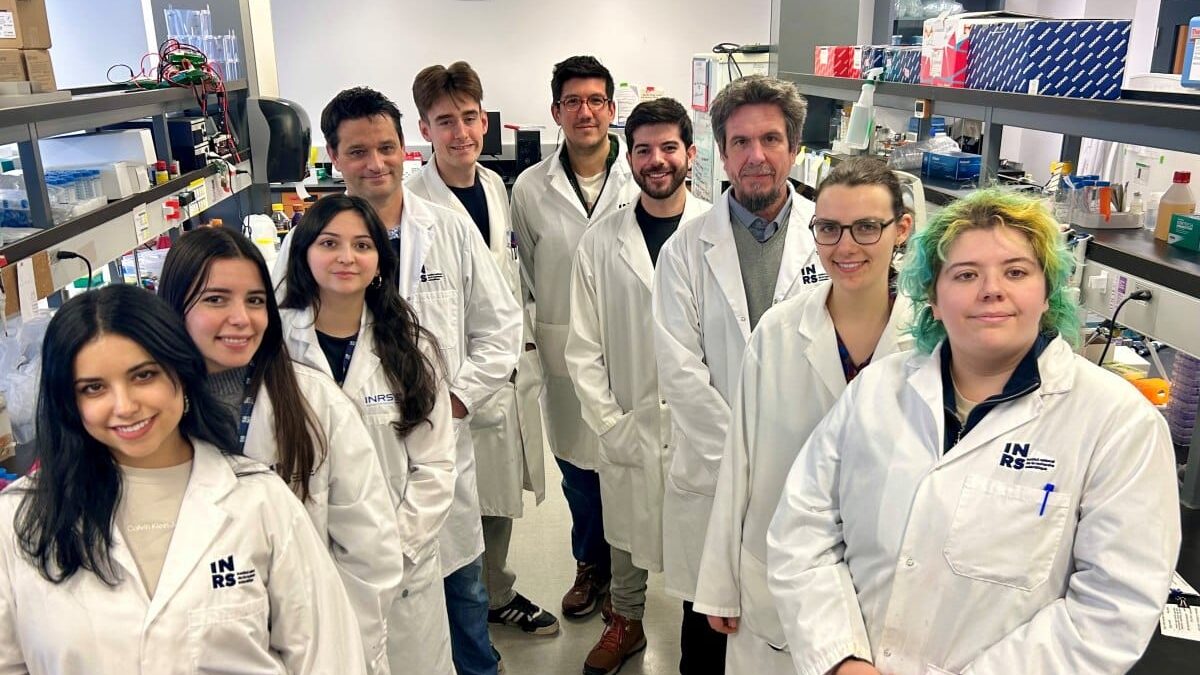
Yago Gomes ( Laurent Chatel-Chaix Lab), Marion Cannac (Sébastien Nisole Lab) et Mathilde Broquière (Laurent Chatel-Chaix Lab).