
- Overview
Bienvenu Irenge Ndagano: Demystifying Quantum Photonics and Understanding Its Impact on Our Society.
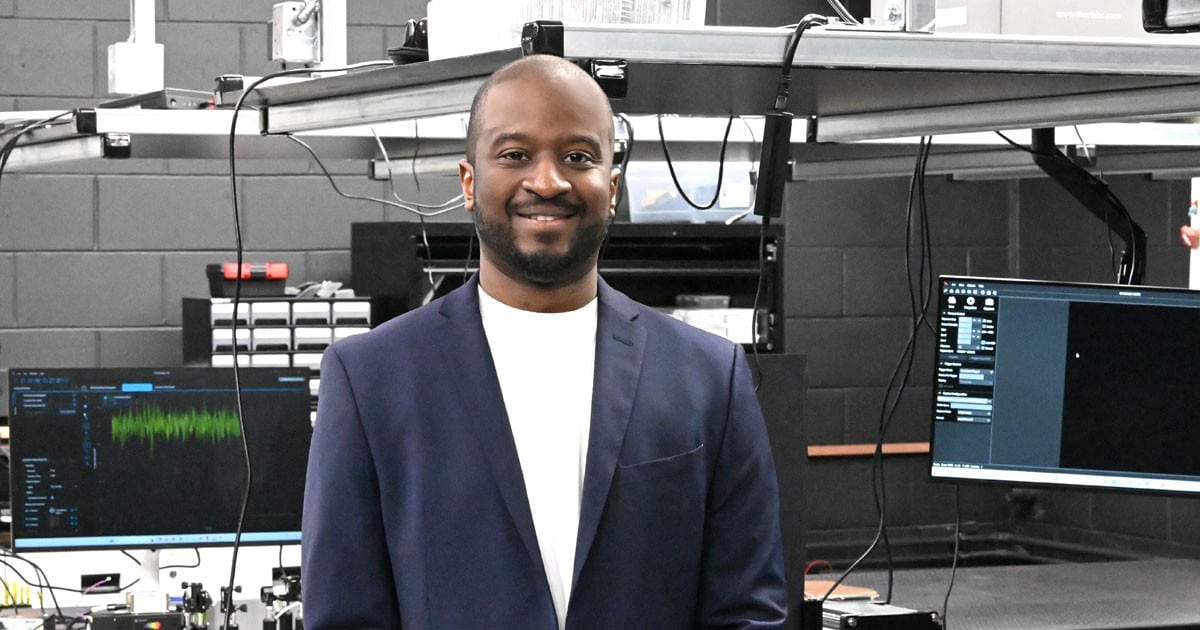
Quantum photonics has emerged as one of the most promising fields for transforming our technologies. By manipulating the properties of photons, it opens the door to ultra-secure communications, more precise imaging, and highly sensitive sensors.
At the Institut national de la recherche scientifique (INRS), Professor Bienvenu Irenge Ndagano, holder of a Quantum Photonics Research Chair funded by Quebec’s Ministère de l’Économie, de l’Innovation et de l’Énergie, explores the multidimensional properties of light to design new approaches in communication, imaging, and detection. Known for his work in quantum communication using structured photons and in quantum imaging, he helps push the boundaries of what light can reveal—from the microscopic world to the networks of tomorrow.
For this series, he demystifies this still little‑known field and explains how, together with his colleagues at the INRS Énergie Matériaux Télécommunications Research Centre, he actively contributes to this scientific revolution.
We often hear about quantum photonics, but it still feels abstract. Can you explain what it is?
It’s a branch of science that can indeed seem abstract. Before diving into it myself, I hadn’t realized the full extent of its potential. And yet!
When we talk about quantum photonics, we refer to physical phenomena that occur at extremely small scales, applied to light. When people think of light, they usually imagine the visible spectrum—the colors we can see. In photonics, however, we study the full range of electromagnetic radiation, both visible and invisible. In quantum science, we focus on its most fundamental aspect: photons, the elementary components of light. Photons travel in small packets of energy—quanta, which is where the word “quantum” comes from.
And in the quantum world, light sometimes behaves like a wave, sometimes like a particle, and can even appear to be in several places at once. These phenomena are counterintuitive—but fascinating.
Understanding these fundamental properties forms the basis of technologies that already shape our daily lives. The laser, for example—used in grocery store scanners, surgeries, or Internet communications—comes directly from quantum science and the study of light.

What applications make quantum photonics a technology of the future?
There are many!
First, there are secure communications, a major focus of my research. In quantum cryptography, it is possible to transmit information photon by photon. One fundamental principle makes this technology unique: a photon cannot be cloned. Any attempt to intercept the transmission creates anomalies detectable by both parties. This is a major advantage for cybersecurity and defense applications.
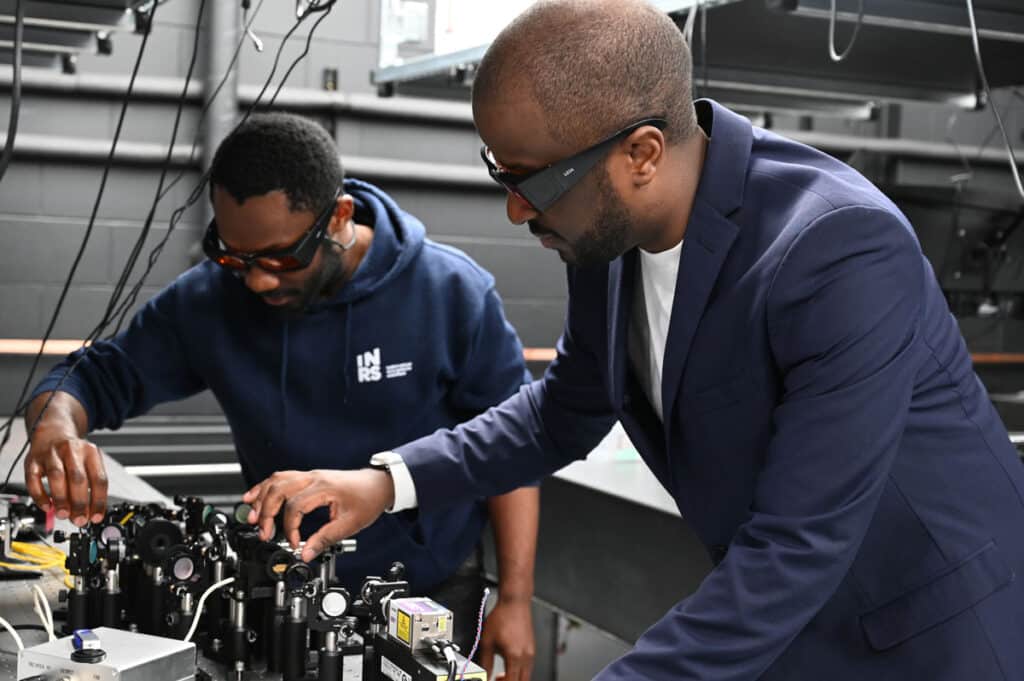
In my laboratory, we also explore new ways of “structuring” light to encode even more information per photon. By using the photon’s shape or direction—like adding extra letters to an alphabet—we can increase the amount of data sent each time. This could enable even faster and more secure communication systems.
Quantum imaging, another one of my specializations, is very promising for biomedicine. Today, observing molecules or cancer cells requires extremely expensive instruments. Quantum effects could make it possible to develop much more affordable microscopes—making them more accessible to laboratories. I develop quantum imaging techniques that allow us to observe very fragile cells with extremely low light, without damaging them. This gives us access to precise information and could help biomedical experts better analyze sensitive or rare samples.For example,certain proteins associated with Alzheimer’s disease are highly light‑sensitive — under strong illumination, they denature and lose their fluorescent properties.
Quantum imaging can also detect molecules or invisible gases such as methane, a powerful greenhouse gas. Ultra‑sensitive quantum sensors could become essential tools for environmental monitoring.
Finally, quantum computing, whose development has been progressing for several years, remains one of the major scientific promises of this field.
How do these technologies stimulate innovation and economic growth, and what benefits do they offer for Québec and Canada?
These technologies stimulate innovation by naturally bringing together research and industry—and I see this every day at INRS. We are used to transforming scientific breakthroughs into concrete solutions.
INRS is also the university in Québec with the largest number of patents in the field of quantum technologies.
Ki3 Photonics, for example, a company stemming from the group of my colleague Professor Roberto Morandotti, develops quantum sources and components to analyze and control quantum fiber‑optic networks. This illustrates the dynamic well: it is a transfer of knowledge that creates value and jobs.
At INRS, we also advance through strategic partnerships. For example, we collaborate with Xanadu, a company developing quantum computers enabled by photonics—where photons are used to execute algorithms. Through a Natural Sciences and Engineering Research Council of Canada’s Alliance program, we work together to accelerate the development of photonic quantum technologies. Such collaborations allow us to test our ideas in real-world conditions while training a highly qualified next generation of researchers.
At the national level, ambitious projects such as the QEYSSat mission of the Canadian Space Agency aim to establish long‑distance quantum communication links through a satellite. This represents an important step toward secure connections without laying thousands of kilometers of fiber.
Overall, Québec and Canada are key players on the international stage—and INRS plays an active role through research, partnerships, and training. Moreover, according to the National Research Council of Canada, the quantum industry could reach $139 billion by 2045. This collective momentum, along with the strength of INRS’s expertise, is what convinced me to join the Énergie Matériaux Télécommunications Research Centre.