- Research Grants
- Research Grants
The Institut national de la recherche scientifique (INRS), the Université du Québec à Trois-Rivières (UQTR), the Quebec Metallurgy Center (QMC) and Innofibre are joining forces to implement a technological platform dedicated to the energy transition. With an investment of $7.6 million from the Ministère de l’Économie, de l’Innovation et de l’énergie (MEIE), this project consolidates the Mauricie and Centre-du-Québec as one of Canada’s strategic regional hubs for energy innovation.
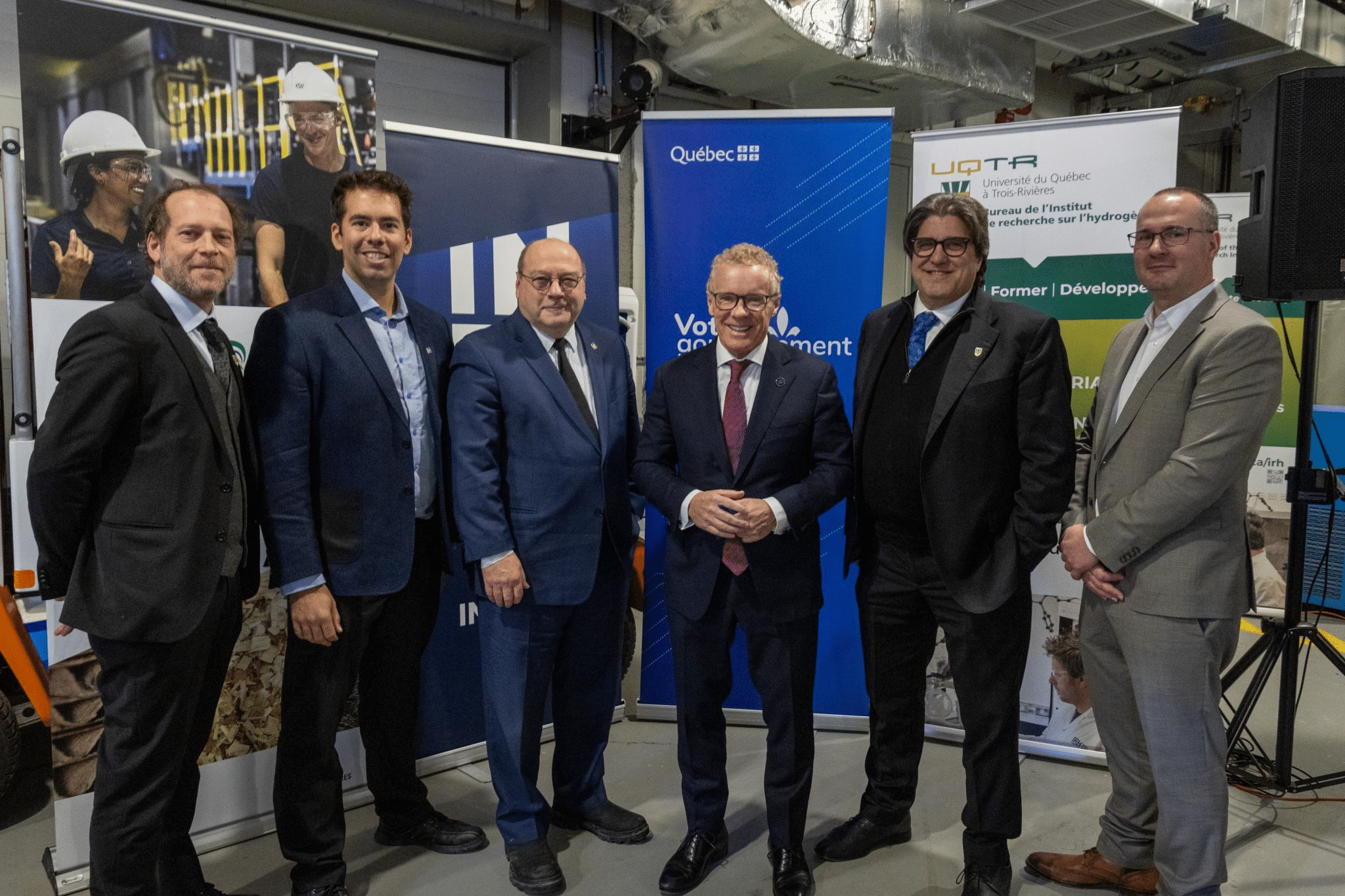
Yves Monette – Director of the Office of Strategic Research Initiatives at UQTR; François Allard – professor at INRS; Luc-Alain Giraldeau – President and CEO of INRS; Jean Boulet – Member of the National Assembly for Trois-Rivières, Minister of Labour and Minister Responsible for the Mauricie Region; Christian Blanchette – Rector of UQTR; Jean-Philippe Jacques – Executive Director of Innofibre at Cégep de Trois-Rivières.
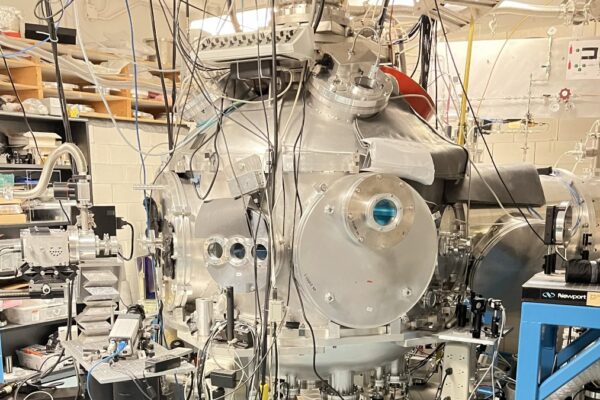
The platform’s 46 new leading-edge scientific instruments will be used to analyze critical nanomaterials such as lithium and graphite, design materials for next-generation batteries, improve energy efficiency in green hydrogen production, and achieve progress in decarbonated industrial processes. These facilities will support the work of the INRS–UQTR Joint Research Unit in Materials and Technologies for Energy Transition, which revolves around three major areas of research: i) New battery materials and technologies, ii) the storage, conversion and production of decarbonized hydrogen and iii) the decarbonization of the industry and the circular economy.
Decarbonization of industrial processes
Given the rapid growth of Quebec’s battery sector, this new equipment will also make it possible to install laboratory-scale prototyping lines and assemblies to simulate the hydrometallurgical, metallurgical and electrochemical processes essential to the development of this industry. INRS–UQTR UMR will thus be able to study Li-ion battery recycling, develop next-generation batteries that offer improved performance, optimize the production of green hydrogen, and promote innovation in industrial processes in support of decarbonization.
The platform will be used to work with industrial partners in three key areas:
- New battery materials and technologies
- Storage, conversion and production of decarbonized hydrogen
- Decarbonization of industrial processes
A concrete driver for INRS-led research
For INRS teams, this platform will act as a major accelerator.
Professor François Allard will be able to conduct more in-depth research on the production of green aluminium, develop more effective battery technologies, and design innovative processes for recycling Li-ion batteries — a critical issue for the growth of Quebec’s battery sector. The new facilities will also give him the means to support the decarbonization of electrical networks by testing cleaner and more effective solutions.
Professor Karin Kleiner also stands to benefit from this platform for purposes of developing Li-ion battery cathodes that do not use cobalt, a rare and costly element. Thanks to this new equipment, she will be able to produce longer-lasting electrodes, reduce our dependency on certain critical materials, and work with industrial partners to accelerate the scale-up of these innovations.
Training emerging scientists and supporting a fast-growing industry
In addition to stimulating innovation, these facilities will play a key role in training. More than 300 students, trainees and researchers are expected to use them in the years to come, including international trainees. The platform will also help support the continued rapid development of Quebec’s battery sector, as 1,500 new workers will be trained in the Bécancour region alone.
A model of collaboration that bears fruit
For INRS, this initiative illustrates the strength of the UMR model.
Luc-Alain Giraldeau, INRS CEO
“These investments clearly demonstrate that the joint research unit (UMR), an INRS initiative, is a model that works. By drawing on a close collaboration between our establishments, we have created a solid research community that pairs expertise with innovation and the establishment of a regional base. The government’s support will serve to accelerate the development of concrete solutions in support of Quebec’s energy transition.”
Through its integration into the Vallée de la transition énergétique, this platform will become an essential lever connecting universities, college centres for the transfer of technology, and industries. It paves the way for cleaner and more effective energy solutions developed right here in Quebec.
You may also like
December 15, 2025
Marc-André Gauthier