- Academic Life
INRS takes concrete action to help ease climate transition.

A new guide to quantifying Scope 3 greenhouse gas (GHG) emissions has just been published by RUQDD (Réseau universitaire québécois en développement durable), a Québec university network on sustainable development to which INRS (Institut national de la recherche scientifique belongs. Developed through close collaboration among Québec universities, this tool aims to make GHG inventories more accurate, more complete, and better harmonized, both within the university community and across organizations and industries.
“Quantifying indirect emissions provides essential information to guide credible climate action. By contributing to this guide, INRS has reaffirmed its commitment to responsible and engaged research that generates positive, sustainable, and equitable impacts for the benefit of society,”
Isabelle Delisle, Scientific Director, INRS
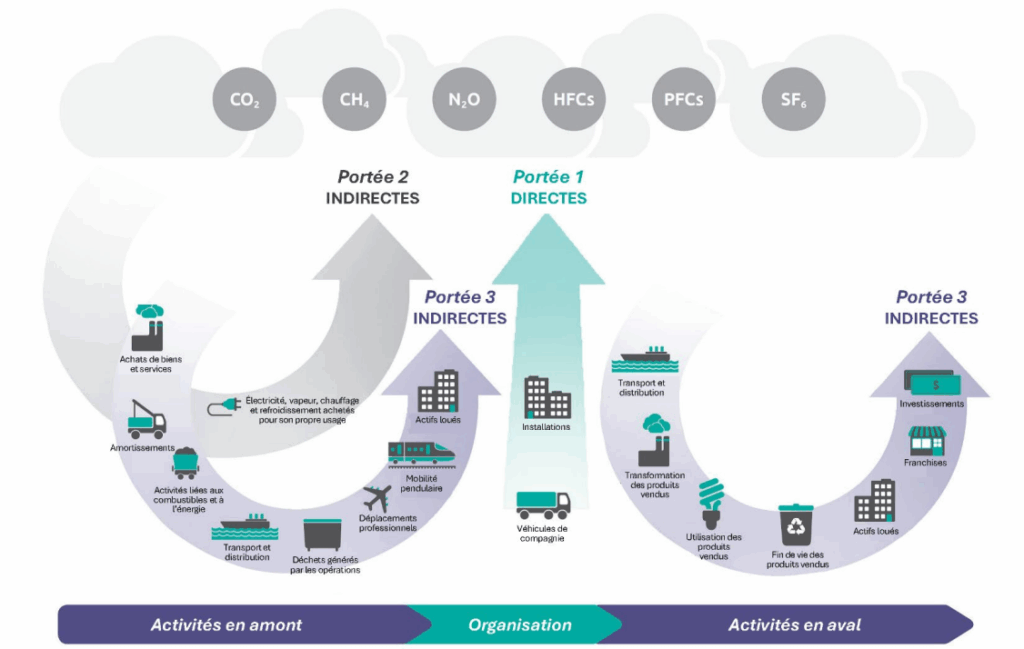
Scope 3 GHG emissions include emissions generated by organization members’ travel, the procurement of goods and services, and the organization of events. Although indirect—and often outside an organization’s operational control—they generally represent the largest share of an organization’s carbon footprint, due to the wide range of sources and calculation methods involved.
A critical tool for better quantification
The guide offers clear, practical, and actionable advice, including:
- recommended quantification approaches
- suggested activity categories
- emission factors to be used
By sharing the knowledge and expertise developed within RUQDD, this guide provides organizations with a better understanding of their indirect emissions sources, bolsters their reduction strategies, and more effectively identifies which climate actions to take.
The guide is reflective of the ongoing commitment of Québec universities to a leadership role in sustainable development and the fight against climate change.
INRS: From measurement to action
As a RUQDD member, INRS contributed to the development of this guide while continuing to implement concrete actions aimed at reducing its direct and indirect GHG emissions.
These actions include:
- Quantifying INRS’s Scope 3 GHG emissions for the first time ever in 2025. This inventory revealed that 46% of INRS’s total GHG emissions stemmed from the purchase of goods and services.
- A decarbonization initiative launched in 2023, resulting from INRS’s commitment to achieving carbon neutrality for Scope 1 and 2 emissions by 2040. A project is currently underway to reduce natural gas consumption at the thermal plant on the Laval campus.
- Energy efficiency measures, including the transition to LED lighting in several buildings, the acquisition of two electric vehicles, the implementation of demand power management in Québec City, and updates to air exchange rates in certain laboratories.
- Numerous sustainable mobility initiatives launched in 2025 to reduce emissions related to commuting for work and studies: discounts on public transit and bike-sharing services, a car-sharing station, new bicycle repair stations and secure bike racks, and workshops on bicycle maintenance held at each location. These efforts were recognized at the 2025 Défi Sans Auto Solo awards.
- In January 2025, a first-ever training session on responsible procurement to make environmental considerations a bigger part of purchasing decisions.
An evolving approach
The launch of this guide marks the first step in a process of continuous improvement. Over the coming year, RUQDD plans to update the tool based on best practices and further add to its recommendations. A companion tool (such as a Scope 3 GHG emissions calculator) is also being considered to make quantification even easier.
Through its contribution to this guide and the actions it is implementing, INRS has reaffirmed its commitment to tracking and measuring emissions as a way to do more to ease the climate transition, in keeping with its mission of research and innovation for the betterment of society.
Participating universities :
École de technologie supérieure • HEC Montréal • Institut national de la recherche scientifique • Polytechnique Montréal • Concordia University • Université de Montréal • Université de Sherbrooke • Université du Québec en Abitibi-Témiscamingue • Université du Québec à Chicoutimi • Université du Québec à Montréal • Université du Québec à Rimouski • Université du Québec à Trois-Rivières • Université du Québec en Outaouais • Université Laval • McGill University • Université TÉLUQ
You may also like