

Given the very rapid development of AI tools, these guidelines may evolve over time. It is vitally important that all students stay abreast of these developments.
As artificial intelligence (AI) is used more and more in into academic and scientific circles, particularly generative AI tools such as ChatGPT and Copilot, we need to think carefully about how it is used and make sure we comply with the highest standards of intellectual and research integrity.
INRS guidelines for the responsible use of AI in education
INRS’s Graduate Studies and Student Success Office has developed guidelines on artificial intelligence. They are set out in the document “Guidelines for the responsible use of artificial intelligence in graduate studies” and are summarized below.
Summary
- Prioritize academic learning: Use AI as a support tool, not as a substitute for developing essential academic skills such as critical thinking, independent research, and writing.
- Obtain prior authorization: Always check whether AI tools are permitted in a given context. Consult INRS’s policies and guidelines to avoid inappropriate use.
- Take responsibility for the content: Take full responsibility for any content produced using AI. Systematically validate that all information is accurate, relevant, and original before incorporating it into your work.
- Understand the associated risks:
- Confidentiality: Sensitive or personal data may be compromised
- Plagiarism: Generated content may include non-original elements without clear attribution.
- Cybersecurity: Some AI tools may expose your information to cyberattacks.
- Algorithmic bias: The results produced may reflect biases present in the training data.
- Environmental issues: Remember that that these tools have a considerable environmental footprint
Maintain a critical mindset and be upfront about using AI tools.

Basic concepts
Artificial intelligence (AI)
“Artificial intelligence (AI) refers to the series of techniques which allow a machine to simulate human learning, namely to learn, predict, make decisions and perceive its surroundings. In the case of a computing system, artificial intelligence is applied to digital data.”
Source : Déclaration de Montréal, Glossaire, https://declarationmontreal-iaresponsable.com/glossaire
Generative AI (GAI)
“Generative AI refers to all artificial intelligence techniques used to produce content via algorithms and big data, usually in the form of text, sound, video, or image files. Generative artificial intelligence can lead to plagiarism or misinformation, particularly when data has been deepfaked. More broadly, chatbots are types of generative artificial intelligence.”
Source : Office québécois de la langue française, Grand dictionnaire terminologique, https://vitrinelinguistique.oqlf.gouv.qc.ca/fiche-gdt/fiche/26561649/intelligence-artificielle-generative
“The term ‘generative’ refers to the ability of AI to automatically create information from large volumes of existing data on which it has been trained. AI does not simply copy and paste what it has analyzed—it imitates, improves, and creates an entirely new result based on a statistical recomposition of the patterns and structures it has identified during its learning process. These results, known as content, can be text, images, music, or computer code.”
Source : Université de Genève, Intelligence artificielle générative: Guide à l’intention de la communauté universitaire, Introduction à l’IA générative https://www.unige.ch/numerique/ia-generative-guide-unige/introduction-ia-generative
Differentiating between AI and GAI
Large language models (LLMs)
“An LLM is large because it has a huge number of parameters (in the order of several billion), all of which are pieces of information. It is a model because it is a neural network trained on a large amount of text to produce non-specific tasks. It is a language model because it reproduces the syntax and semantics of natural human language by predicting the sequence likely to follow a given input. This is also the source of the general “knowledge” it has acquired from its training texts.”
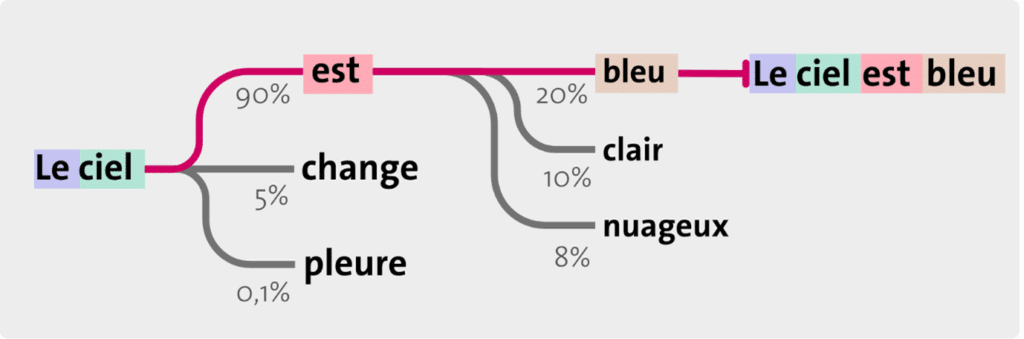
Source : Intelligence artificielle générative. Guide pratique de l’UNIGE. Introduction à l’intelligence artificielle générative. Université de Genève.
Issues and limitations
When using AI tools, be aware of the associated challenges and limitations and consider whether they are being used appropriately and responsibly.
A hindrance to acquiring essential skills: AI should be a complementary tool and not a substitute for intellectual work. It should not compromise the acquisition of essential academic skills such as critical analysis or writing, research, or problem-solving skills.
Exposure of sensitive data: Personal, confidential, or unpublished data such as research results should never be shared with AI tools without explicit approval. These tools may store or analyze data in unpredictable ways, which can pose serious risks to confidentiality and cybersecurity. Remember—all uses involving sensitive data must comply with the INRS Privacy Policy.
Cybersecurity risk: Sharing data via online AI platforms may expose users to cyberattacks or data breaches.
Algorithmic bias and reliability of responses: AI tools do not guarantee that the responses they generate are accurate or objective. The results may also reflect biases in the training databases, which can hinder diversity and inclusiveness.
Intellectual property and plagiarism: Using AI-generated content may lead to potential breaches of intellectual property rights such as copyright. AI tools may rely on protected data or works without the permission to do so, exposing users to litigation. AI tools must be used in accordance with the rules governing citations, references, and attribution of sources.
Environmental and human issues: AI tools have direct and indirect impacts on the environment (e.g., raw materials to manufacture AI equipment, water to cool servers and energy to train AI tools, etc.) but also on society, particularly the labour market (i.e., automation of certain tasks, new skills for employees, etc.). etc.) but also on society, particularly the labor market (i.e., automation of certain tasks, new skills for employees, etc.).
Resources and references
Voir tout
Ressources
- Balises sur l’utilisation responsable de l’IA aux études supérieures (pdf) – version anglaise (pdf)
- Fiche de déclaration d’utilisation de l’IAg (doc)
- Declaration form – use of generative artificial intelligence (doc)
Sources consulted for the guidelines
- Université de Montréal, Lignes directrices pour une utilisation appropriée de l’intelligence artificielle (IA) générative aux études supérieures à l’Université de Montréal, É.s.e. postdoctorales, Editor. 2024, Université de Montréal, en ligne https://esp.umontreal.ca/fileadmin/esp/documents/PDF/Lignes_directrices_Utilisation_IA_Memoire_et_these_Octobre2024.pdf [consulté le 15 janvier 2025]
- Université de Sherbrooke, Lignes directrices pour l’utilisation de l’intelligence artificielle générative à l’Université de Sherbrooke, en ligne https://www.usherbrooke.ca/decouvrir/a-propos/priorites-institutionnelles/intelligence-artificielle/lignes-directrices-iag [consulté le 3 février 2025]
- Conseil supérieur de l’éducation et Commission de l’éthique en science et en technologie (2024). Intelligence artificielle générative en enseignement supérieur : enjeux pédagogiques et éthiques, Québec, Le Conseil; La Commission. En ligne https://www.cse.gouv.qc.ca/publications/ia-enseignement-sup-50-0566/ [consulté le 15 janvier 2025]
- Université de Genève, Introduction à l’IA générative de l’Université de Genève – en ligne https://www.unige.ch/numerique/fr/plan-daction/ia1/accueil/guide-pratique-ia/introduction-lia-generative/ [consulté le 3 mars 2025]
- Université du Québec. (2025). Énoncé de principes sur l’utilisation responsable de l’intelligence artificielle générative dans les activités de formation et de recherche. Vice-présidence à l’enseignement et à la recherche
Some AI glossaries (non-exhaustive list)
- Gouvernement du Canada, Carte conceptuelle de la terminologie de l’intelligence artificielle (IA)
- Office québécois de la langue française, Une intelligence artificielle bien réelle : Les termes de l’IA
- Déclaration de Montréal IA responsable, Glossaire
- Observatoire international sur les impacts sociétaux de l’IA et du numérique (Obvia), Glossaire
- Frise historique de l’IA tiré du Mooc Intelligence artificielle pour et par les enseignants, plateforme FUN https://view.genially.com/64e486d0efc8e200198a554b
Additional resources and tools
- TÉLUQ : Étudier à l’ère de l’IA – Parlons intégrité… et plagiat – Cette page web présente plusieurs bonnes pratiques, ressources et cas de figure en lien avec l’IA et l’intégrité intellectuelle
- Université de Montréal : https://bib.umontreal.ca/evaluer-analyser-rediger/iag – cette page propose des repères pour une utilisation responsable d’IAg en contexte académique
- Université du Québec en Outaouais – https://pupp.uqo.ca/fr/intelligence-artificielle-et-plagiat/ – cette page web regroupe des articles, des pistes de solutions et des recherches sur l’intelligence artificielle, le plagiat et l’intégrité intellectuelle
- HEC, Comment utiliser l’intelligence artificielle générative de manière responsable, https://www.hec.ca/etudiants/soutien-ressources/intelligence-artificielle-generative/utilisation-responsable/index.html [consulté le 29 avril 2005] – cette page web présente de bonnes pratiques pour intégrer l’IAg de manière responsable et alignée avec les exigences académiques
- Billet 6 – La recherche assistée par l’IA – Faculté des arts et des sciences – Université de Montréal [consulté le 3 mars 2025] – ce billet traite du potentiel d’utilisation de l’IA en recherche et en pédagogie et des défis associés
- Durabilité à l’Ère du Numérique – L’IA et l’environnement : une arme à double tranchant [consulté le 2 mai 2025] – cette publication présente les avantages, les enjeux et des solutions en regard de l’IA et de l’environnement
- LiterIA – Outils et tutoriels https://literatia.ca/outils-et-tutoriels/ [consulté le 3 mars 2025] – cette page regroupe de courtes capsules vidéos sur divers sujets en lien avec l’IA : comprendre ChatGPT pour les débutants, génération de texte, génération d’image.



Questions? Contact us at the following address