
- Research
An INRS discovery opens new avenues against bacterial resistance.
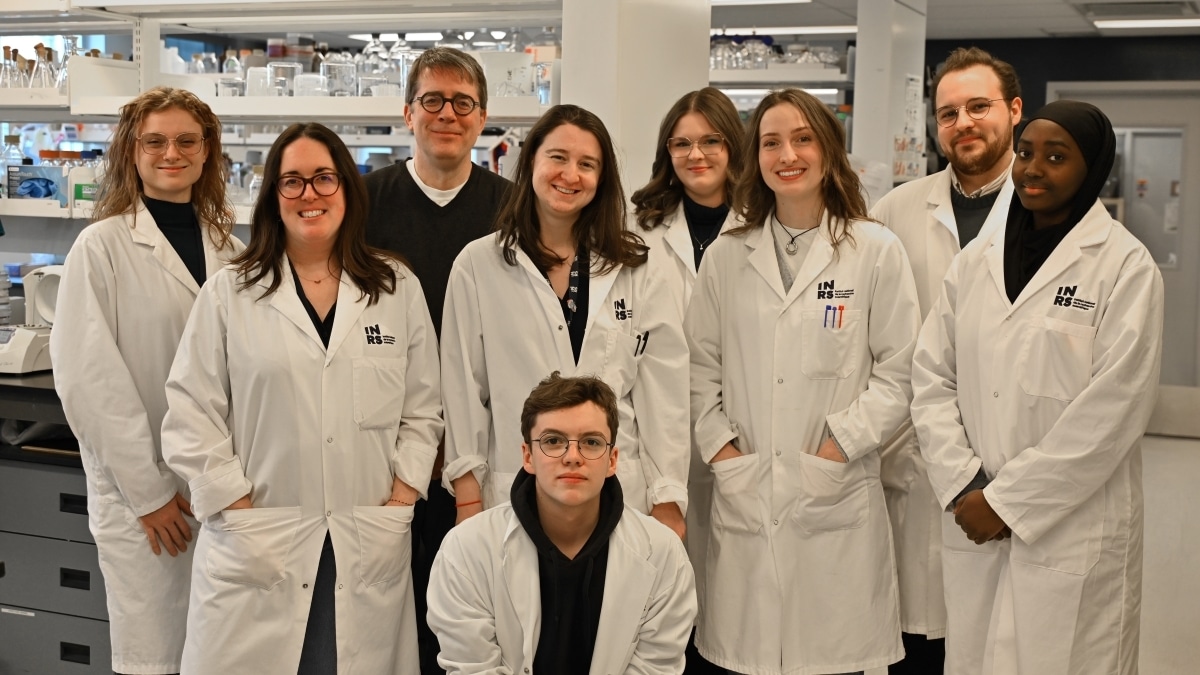
Professor Éric Déziel and his team. From left to right: Sandrine Gervais, Marie-Christine Groleau, Éric Déziel, Mylène Trottier, Ivan Zelenyy, Maude Dagenais Roy, Camille Chartyrand-Pleau, Louis-Thomas Lafrance et Odile Badiane.
Each year, more than 400 million people worldwide, most of them women, experience urinary tract infections (UTIs), most commonly caused by the bacterium Escherichia coli. While antibiotics such as fosfomycin remain first-line treatments, the growing issue of antimicrobial resistance is increasingly undermining their effectiveness and prompting the search for complementary strategies.
Research led by Professor Éric Déziel, a microbiologist at the Institut national de la recherche scientifique (INRS) and Canada Research Chair in Fundamental and Applied Sociomicrobiology, suggests that cranberry juice may play an unexpected role by enhancing the effectiveness of certain antibiotics while slowing the emergence of resistance, at least under laboratory conditions. The findings were published in the journal Applied and Environmental Microbiology of the American Society for Microbiology.
“Finding ways to help antibiotics work better could extend their useful life without the need to develop new drugs. ”
Professor Déziel, microbiologist at INRS and the study’s lead author
Conducted in collaboration with INRS Professor Charles Dozois’s team, also based at the INRS Armand-Frappier Santé Biotechnologie Research Centre and specializing in E. coli, this study is the first to demonstrate a direct interaction between cranberry juice and an antibiotic.
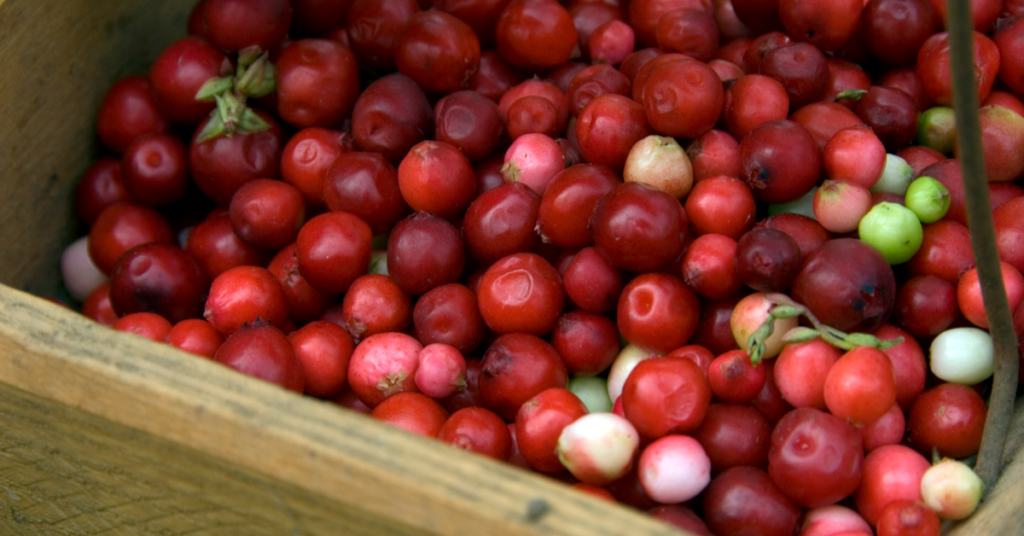
This s builds on earlier collaborative work between the team of Professor Nathalie Tufenkji at McGill University and that of Professor Éric Déziel, which had already shown that concentrated cranberry extracts can increase bacterial sensitivity to antibiotics, a promising avenue in the fight against antimicrobial resistance.
A Natural Boost for Antibiotics
In this study, pathogenic strains of E. coli grown in the laboratory were exposed to fosfomycin in the presence of cranberry juice. The result was that, in 72 percent of the strains tested, cranberry juice enhanced the antibiotic’s effectiveness and reduced the occurrence of mutations linked to resistance.
The researchers found that certain compounds in cranberry affect how bacteria transport sugars. In the presence of cranberry juice, bacteria take in more of these sugars, which leads at the same time to increased uptake of the antibiotic. This occurs because fosfomycin uses the same transport pathways to enter bacterial cells. This mechanism likely explains the observed effect.

“What surprised us most was that such a common product as cranberry juice could alter how bacteria respond to an antibiotic. This opens up new possibilities for making better use of the treatments we already have.”
Marie-Christine Groleau, research professional at INRS and the study’s first author.
A Lead Worth Exploring Further
This work remains exploratory, and further research will be needed to determine whether the same effect occurs in humans and under what conditions.
“We still don’t know whether the active compounds in cranberry juice actually reach the site of infection after consumption, or in what amounts,” notes Professor Déziel.
These findings are part of a broader effort to preserve antibiotic effectiveness. Using natural compounds to support the action of existing drugs could represent a promising approach to addressing antimicrobial resistance, one of today’s major public health challenges.
About the Study
Groleau M, Houle S, Quevedo AC, McKay G, Nguyen D, Dozois CM, Tufenkji N, Déziel E. 0. Cranberry juice potentiates sensitivity of uropathogenic Escherichia coli (UPEC) strains to fosfomycin and decreases occurrence of spontaneous resistance. Appl Environ Microbiol 0:e02521-25. https://doi.org/10.1128/aem.02521-25
This research was funded by the Cranberry Institute, the Canada Research Chairs Program, and the Canada Foundation for Innovation.